EV Charging Equipment / Application Solution
EV Charging Cable Management Spring Solution
XSD Precision helps EV charging equipment teams assess spring-assisted cable support, return and routing structures for cable dragging, tangling, sharp-bend and outdoor durability risk.
Where This Solution Fits
Cable dragging and abrasion risk
Useful where cable ground contact, jacket wear or repeated pressure needs an engineering review.
Tangling or unstable return
Useful where cable routing, return behavior or operating path is inconsistent.
Controlled support in limited space
Useful where cable load, mounting position, working travel and bend radius need to be coordinated.
When Another Route May Fit Better
No defined mounting boundary
A spring unit should not be selected before fixing points, motion range and installation space are understood.
Cable issue caused by unrelated hardware failure
Damaged connectors, electrical faults or missing cable-management hardware need their own corrective route.
Fixed performance promise without validation
Wire size, load, life and environmental performance must be confirmed per project, not assumed from a public page.
Working Principle
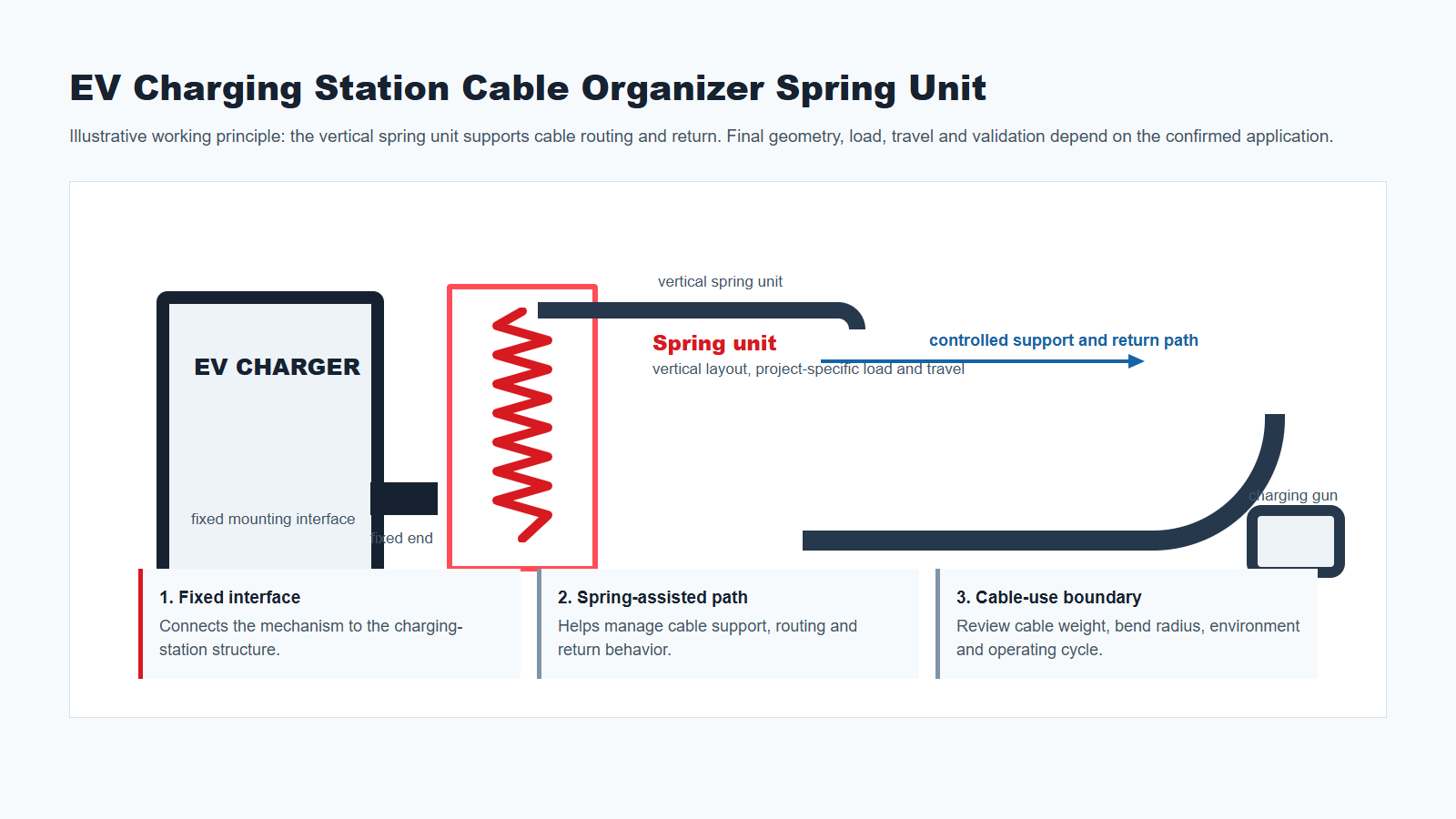
Engineering Review Path
Define the problem
Confirm dragging, tangling, wear, poor return or sharp-bend risk.
Review boundaries
Check cable and charging-gun load, space, mounting and motion path.
Select the route
Define spring behavior, material direction, end form and interface concept.
Sample and validate
Review load, return, assembly, fatigue and environmental needs.
Control production
Lock approved BOM, process controls, inspection, packaging and traceability.
EV Cable Management RFQ Inputs
| RFQ input | What to confirm | Engineering meaning |
|---|---|---|
| Cable and charging-gun data | Weight, outer diameter, exposed length and minimum bend radius | Sets the load and routing boundary |
| Installation and movement | Mounting interface, height, working travel and possible interference | Sets the structure and assembly route |
| Use environment | Indoor/outdoor use, temperature, rain, salt exposure and dust | Sets material and validation direction |
| Operation and life | Operating frequency, return expectation, user pull-force and life target | Sets durability review scope |
| Quality and project control | Drawing/sample, acceptance criteria, inspection, traceability and packaging | Sets review depth and production evidence |
Downarm and High-Cycle Cable Support Review
Downarm system fit
For EV charger cable management projects, a downarm or guided support route is worth reviewing when the cable needs to stay lifted, return predictably, and avoid repeated ground contact near the charging gun.
High-cycle charging sites
Busy charging stations should check cable weight, bend radius, pull feel, return force, outdoor corrosion exposure, and daily operating cycles before selecting a spring-assisted support structure.
RFQ inputs
Useful inputs include cable diameter and weight, exposed length, mounting height, available swing path, fixing points, operating frequency, target life, and any sample or drawing that defines the installation boundary.
Technical Claim and Information Boundary
This page describes an application-review method, not a fixed product specification. Wire diameter, load, travel, fatigue target, environmental resistance and acceptance criteria are confirmed only against the customer application, drawing or sample and agreed validation route. Customer drawings, project parameters, field photos, raw test data, commercial terms and unpublished intellectual-property details are controlled project information.
Common Questions
What EV charging station projects can use this spring unit?
It is mainly reviewed for charging equipment where cable dragging, ground abrasion, repeated bending, return behavior or cable-storage efficiency creates a reliability or user-experience risk.
Can XSD Precision customize the structure?
Yes. Mounting interface, working travel, load curve, material, surface protection and validation route are reviewed against the customer’s drawing, sample, installation space and operating cycle.
What information should customers provide for review?
Useful inputs include drawing or sample, cable weight, charging-gun weight, available mounting space, required travel, bend-radius limit, operating environment and cycle-life target.
How is performance validated?
Typical validation can include dimensional inspection, load and travel testing, fatigue review, assembly fit, environmental exposure and project-specific acceptance checks.
EV Cable Management Topic Path
These pages are organized around one engineering problem path: identify cable dragging, tangling and wear causes, then review spring-assisted return, design boundaries, manufacturing capability and RFQ inputs.
Related Engineering Resources
- How EV cable organizer spring units reduce cable damage
- How to choose an EV cable organizer spring unit
- RFQ information needed before quotation
- Common EV charging cable management design mistakes
- How XSD validates EV cable organizer spring unit performance
- Cable organizer spring unit quality control article
- EV cable management design checklist
- Precision spring manufacturing capability
- Download the EV cable organizer spring unit engineering review sheet
- Download the EV cable organizer spring unit RFQ intake sheet
XSD Precision helps EV charging equipment teams assess spring-assisted cable support, return and routing structures for cable dragging, tangling, sharp-bend and outdoor durability risk.
Download EV RFQ Intake SheetSubmit EV Cable Management Project